I’m a Wildly Promiscuous Guy
I’ve loved fantasy for as long as I can remember. Loved it before I even knew there was a genre called fantasy.
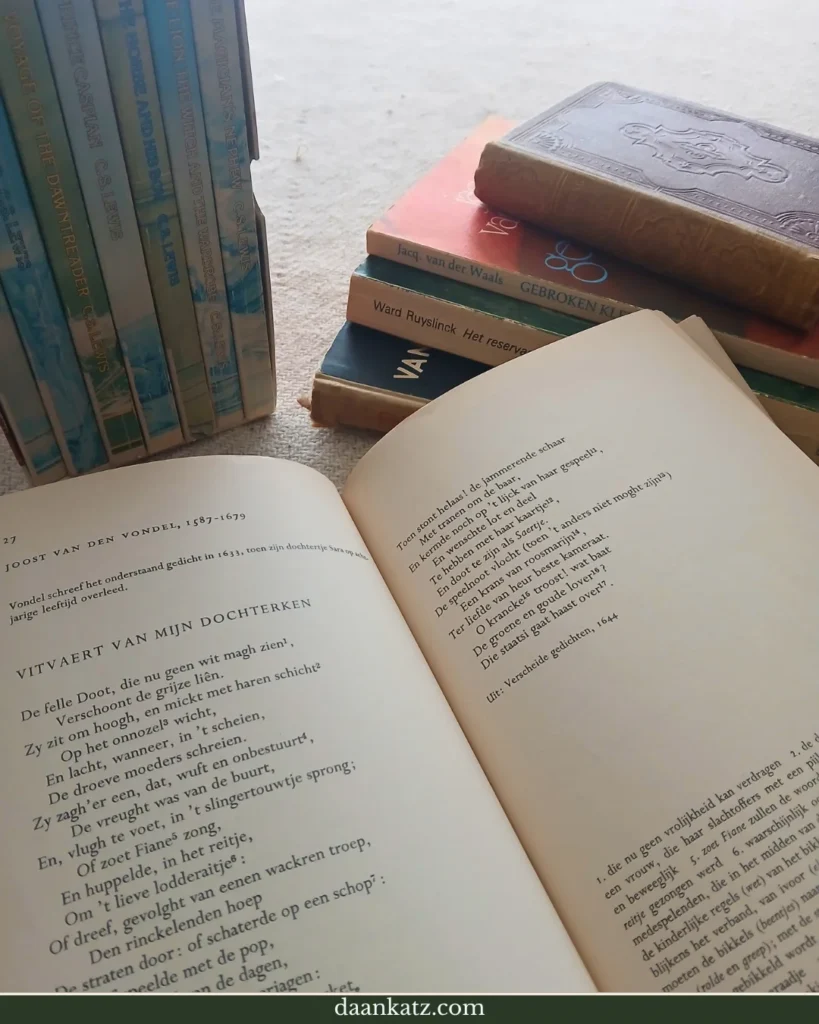
Growing up on a diet of oral storytelling, Biblical tales, Dutch literature, and fairy tales, I knew just one thing: stories were stories, and books were books. Genre meant nothing to me.
And that has consequences.
Storytelling, Dutch Literature, and Fairy Tales
Unlike many modern fantasy authors, I didn’t grow up on a diet of Tolkien, Brandon Sanderson, or (heaven forbid!) Harry Potter. In fact, neither Sanderson nor Rowling had any books to their names yet.
As a child, I read the entire Five Find-Outers, Famous Five, and Adventure Series by Enid Blyton (all in Dutch translation). And, to be completely honest, I even read my sisters’ St Clare’s and Malory Towers books… In fact, I read just about everything with text…
The stories I loved most as a child were the made-up tales my grandmother told me (about two children growing up in a little house at the edge of the woods), and Sans Famille (Nobody’s Boy) by Hector Malot, that my schoolmaster read that to us in class when I was about eight years old—in its Dutch translation Alleen op de Wereld. I loved every minute of it. Of course, it didn’t hurt that my schoolmaster was a brilliant storyteller. But the story itself absolutely left a deep and lasting impression on my developing mind. I think, in many ways, this story shaped me as a writer.
Then there were, of course, the many fairy tales—again, told by my grandmother—and my visits to Efteling’s Fairytale Forest, which to young me was about the best thing ever. Unlike today, there were no other attractions yet. It was just the Fairytale Forest, a swimming pool, a lake, a restaurant, and a steam train. No roller coasters, no golf park, no holiday village, or other big tourist attractions. Here, I could inhabit all the fairy tales I loved so dearly, and every single visit was pure delight.
So, thinking of fantasy, my mind doesn’t immediately go to what’s traditionally viewed as fantasy in the English-speaking world. Instead, it takes me back to my childhood days, where magic was as real as arithmetic.
But childhood doesn’t last forever, and primary school school leads to secondary school. A whole new era.
Compulsory Reading Across Four Languages
Here, my literary world expanded. Dramatically.
Where, up until then, I’d only been reading the books my parents already owned and approved of, and the books I bought with my pocket money (ƒ0.25 a week, with the average book costing ƒ2.25), I now gained access to the school library.
Not only that, but I was taught English, French, and German, too, which meant I could now read books in no less than four different languages. In fact, I was required to do so. For my final exams, I had to read 30 Dutch books (original Dutch literature only, covering all periods in Dutch literary history), and 10 (or was it 15?) books in English, French, and German each.
I won’t bore you with an exhaustive list of everything I read for school, but here are just a few titles, in no particular order.
Dutch
- Karel ende Elegast
- Mariken van Nieumeghen
- Van den Vos Reynaerde
- Jephta, by Joost van den Vondel
- Gekke Witte, by Anton Koolhaas
- Het Reservaat, by Ward Ruyslinck
- Het Achterhuis, by Anne Frank
- Hersenschimmen, by Bernlef
And many, many other literary works. Novels, plays, and poetry bundles.
English
- Watership Down, by Richard Adams
- Animal Farm, by George Orwell
- The Old Man and the Sea, by Ernest Hemingway
- The Hobbit, by J.R.R. Tolkien
- The Lion, the Witch, and the Wardrobe, by C.S. Lewis
- Go Ask Alice, by Beatrix Sparks
French
- Huis Clos, by Jean-Paul Sartre
- En Attendant Godot, by Samuel Beckett
- Le Petit Prince, by Antoine de Saint-Exupéry
German
- Die Verwandlung, by Franz Kafka
- Die Leiden des jungen Werthers, by Johann Wolfgang von Goethe
- Der Richter und sein Henker, by Friedrich Dürrenmatt
Literary Promiscuity
If, looking at Sartre, Tolkien, Hemingway, Anne Frank, Vondel, Orwell, Kafka, Beckett, and Dürrenmatt, you find yourself wondering what kind of reader I am… Well, the answer can only be this: a wildly promiscuous one.
And that leads to the next question: when someone grows up on such a varied literary diet, what kind of writer do they become?
But that’s a story for another time.